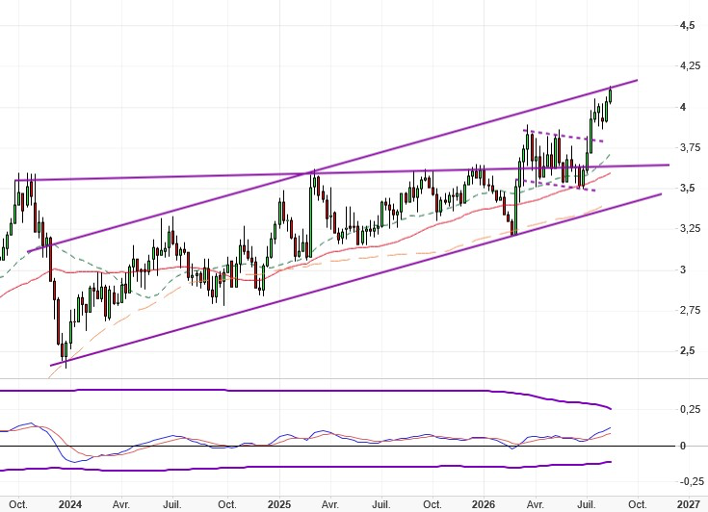
Last May, we anticipated the end of the downward resistance in French long-term yields and expected the 10-year OAT yield to rise towards 4.10%. That target has now been reached.
While this scenario has materialized, the underlying mechanism reflects both global geopolitical factors and France-specific vulnerabilities.
Short term: upward pressure driven by energy and sovereign risk.
Initially, continued geopolitical tensions in the Middle East and the recovery in oil prices have revived concerns about imported inflation in the euro area. This dynamic could force the European Central Bank (ECB) to remain cautious in its approach to policy-rate cuts.
At the same time, uncertainty surrounding France’s fiscal position and the high level of the budget deficit are increasing the country-specific risk premium demanded by investors—reflected in the OAT–Bund spread. This is pushing long-term yields higher and increasing the debt-servicing burden.
Longer term: a moderating effect from slower economic growth.
Over a longer horizon, however, this move may ultimately face its own constraints. The combined shock of higher energy costs and tighter financial conditions will weigh on consumption and investment. A slowdown in global economic activity should gradually ease inflationary pressures, which could lead the ECB to further loosen monetary policy and, in time, stabilize long-term bond yields.
From a technical-analysis standpoint, caution remains warranted. A decisive break above the upper boundary of the ascending channel in which the 10-year yield has been traded since 2024 would confirm a continuation of the uptrend on a larger scale.