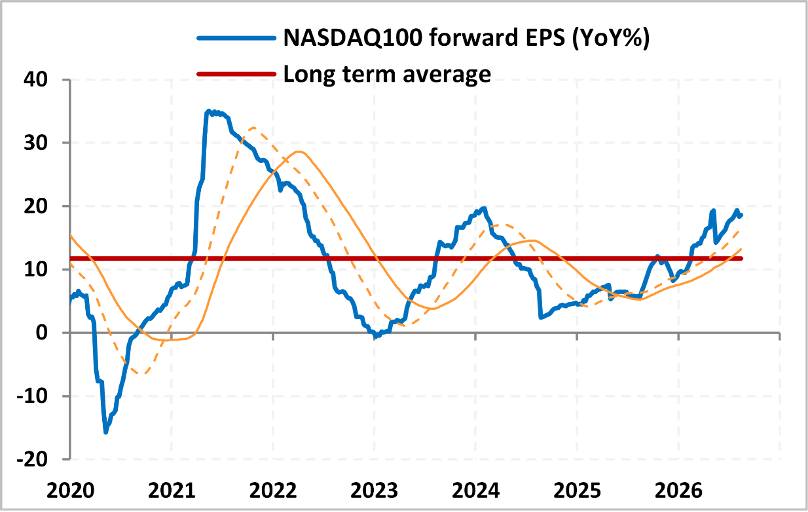
Overall, the market has responded positively to the second-quarter 2026 earnings season, albeit with an important nuance: strong results are no longer being rewarded automatically.
Reported fundamentals have nevertheless been very solid. As of 10 August, 86% of S&P 500 companies that had reported had beaten earnings expectations, while 76% had exceeded revenue expectations.
The technology sector also recorded one of the strongest positive-surprise rates, with 90% of companies beating earnings forecasts and 86% surpassing sales expectations. However, the market reaction within the Nasdaq has become far more selective, particularly depending on companies’ ability to demonstrate that their substantial AI investment is translating into tangible growth and cash-flow generation.
One data point stands out: positive earnings surprises are receiving relatively limited rewards. Companies that beat earnings expectations gained only 0.4% on average from two trading days before to two trading days after their announcements, compared with a five-year historical average of 1.0%.
This may point to a market in which much of the positive news has already been priced in. The largest Nasdaq names illustrate this selectivity particularly well.
While 12-month earnings momentum remains elevated at 18.6%, compared with 8.9% at the beginning of the year and a 10-year average of 11.7%, the reaction to earnings releases has been more mixed.
Among the 20 largest Nasdaq-100 companies, the picture is striking: earnings growth is excellent, but the market reaction to results announcements has been clearly less favorable.
Based on our calculation of “Earnings Reaction Breadth” across these stocks, the indicator currently stands at 35.3% (6 out of 17). In other words, only around 35% of large Nasdaq-100 constituents were rewarded by the market following their latest earnings releases, while nearly 65% declined.
The result becomes even more noteworthy when looking at the performance distribution: the median return across our sample was approximately -6.6%.
The issue, therefore, is clearly not earnings growth. Rather, it is the level of expectations already embedded in share prices. This does not imply that earnings are set to decline; it simply indicates that the market’s sensitivity to positive earnings news has deteriorated.
Nvidia’s next earnings release, scheduled for 26 August, will be a particularly important test. Given its current weighting in the Nasdaq-100, the stock’s reaction could provide a strong indication of the level of expectations that the market is now imposing on AI-related companies.