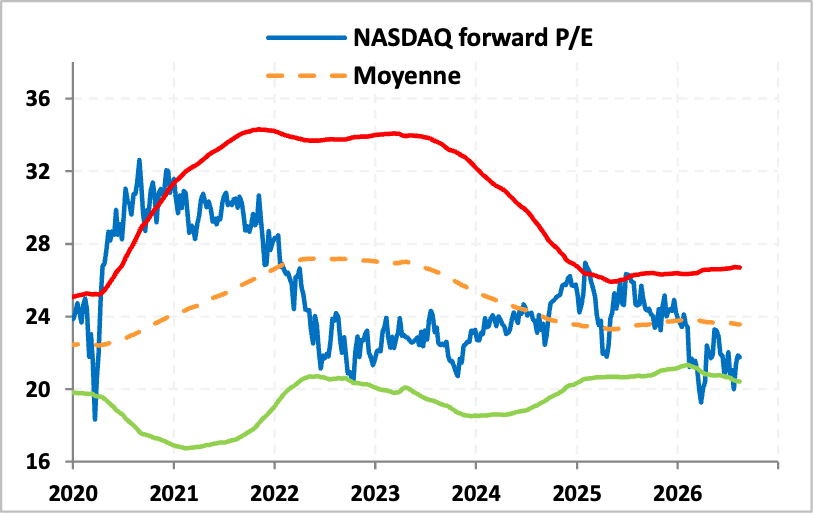
In a recent study published on 17 August, European Central Bank (ECB) experts raised concerns about what they consider to be extreme valuations among major US technology companies. Fueled by enthusiasm surrounding artificial intelligence, the institution says these stocks face a high risk of a sharp correction.
To support this analysis, the ECB notably highlights the Shiller P/E—also known as the CAPE ratio—which is currently close to its historical highs. The observation is accurate: the cyclically adjusted price-to-earnings ratio currently stands at 42, approaching the all-time record of 44 reached at the peak of the year 2000.
However, this indicator is based on the average of inflation-adjusted earnings over the previous ten years. Equity valuations, by contrast, are primarily determined by future financial prospects.
For comparison, in March 2000, the Nasdaq-100’s 12-month forward P/E ratio peaked at around 60 times expected earnings, while that of the Nasdaq Composite rose to 90 times. At the time, more than half of listed companies were reporting net losses, distorting earnings-multiple calculations and forcing analysts to rely on the price-to-sales ratio instead.
Today’s configuration is fundamentally different.
The Nasdaq’s forward P/E currently stands at a substantially more reasonable 21.8x, while the AI-focused segment trades at around 25 times 12-month forward earnings. More importantly, unlike the speculative companies of the dot-com era, most listed AI players are already generating substantial cash flows and robust profitability.